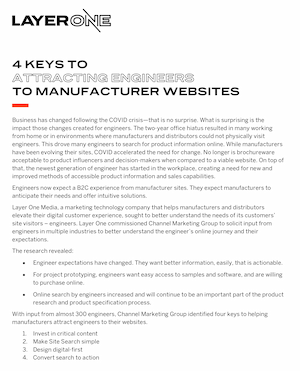
Attracting engineers starts with understanding how their expectations have changed. Engineers now rely on manufacturer websites for fast, accurate technical information and intuitive tools that help them compare and validate products. This guide shares insights from nearly 300 engineers and highlights where manufacturers fall short, along with clear steps to strengthen content, simplify search, and create a smoother digital experience. You will gain a sharper view of what engineers need, how they make decisions, and how to turn your site into a trusted resource that supports their work.
Read or download the Four Keys to Attracting Engineers to Manufacturers’ Websites Guide. No strings attached. Discover what engineers look for, where they struggle, and how your site can deliver a stronger, more intuitive experience that drives engagement, trust, and project conversions.
Read or download the White Paper: 4 Keys to Attracting Engineers to Manufacturer Websites, no strings attached:
Want to understand how engineers experience your site? Share a few details and our team will connect with you.
About Layer One’s White Paper: Four Keys to Attracting Engineers to Manufacturers’ Websites
The Four Keys to Attracting Engineers to Manufacturers’ Websites Guide was developed by Layer One to help manufacturers understand how engineers evaluate digital experiences and what influences their decision-making. Based on research from nearly 300 engineers across mechanical, electrical, process, R&D, and systems integration roles, the guide delivers practical insights manufacturers can use to improve usability, strengthen content quality, and support project workflows more effectively.
The study highlights a rapidly changing landscape for engineers. Many now work remotely, rely heavily on online research, and expect manufacturer websites to function as comprehensive, accurate, and intuitive technical resources. Engineers consistently shared frustrations with incomplete product information, difficult navigation, inconsistent search results, and a lack of accessible tools like CAD files, BIM models, product comparisons, and real application guidance. These gaps often push engineers to distributor websites or competitor brands that provide a smoother research experience.
The guide outlines four core levers manufacturers can use to attract and retain engineer attention. First, investing in critical content ensures engineers can quickly access specs, drawings, 3D files, safety sheets, application details, and product comparisons. Second, simplifying site search enables engineers to find the right products efficiently, whether they are early in conceptual design or validating specific part details. Third, designing digital-first aligns the entire experience around accessibility, ease of use, and a clear presentation of technical depth. Finally, converting search to action focuses on enabling meaningful next steps such as requesting samples, contacting a local distributor, downloading software tools, or sharing detailed product information with peers and project stakeholders.
For manufacturers focused on improving discovery, increasing product specification, and strengthening long-term trust with engineering teams, this guide offers structured insights, real feedback from practicing engineers, and actionable best practices for enhancing your website. Packed with research findings, behavior trends, and digital improvement strategies, it gives your team a blueprint for evolving your site into the authoritative resource engineers expect throughout the design, validation, and procurement stages.